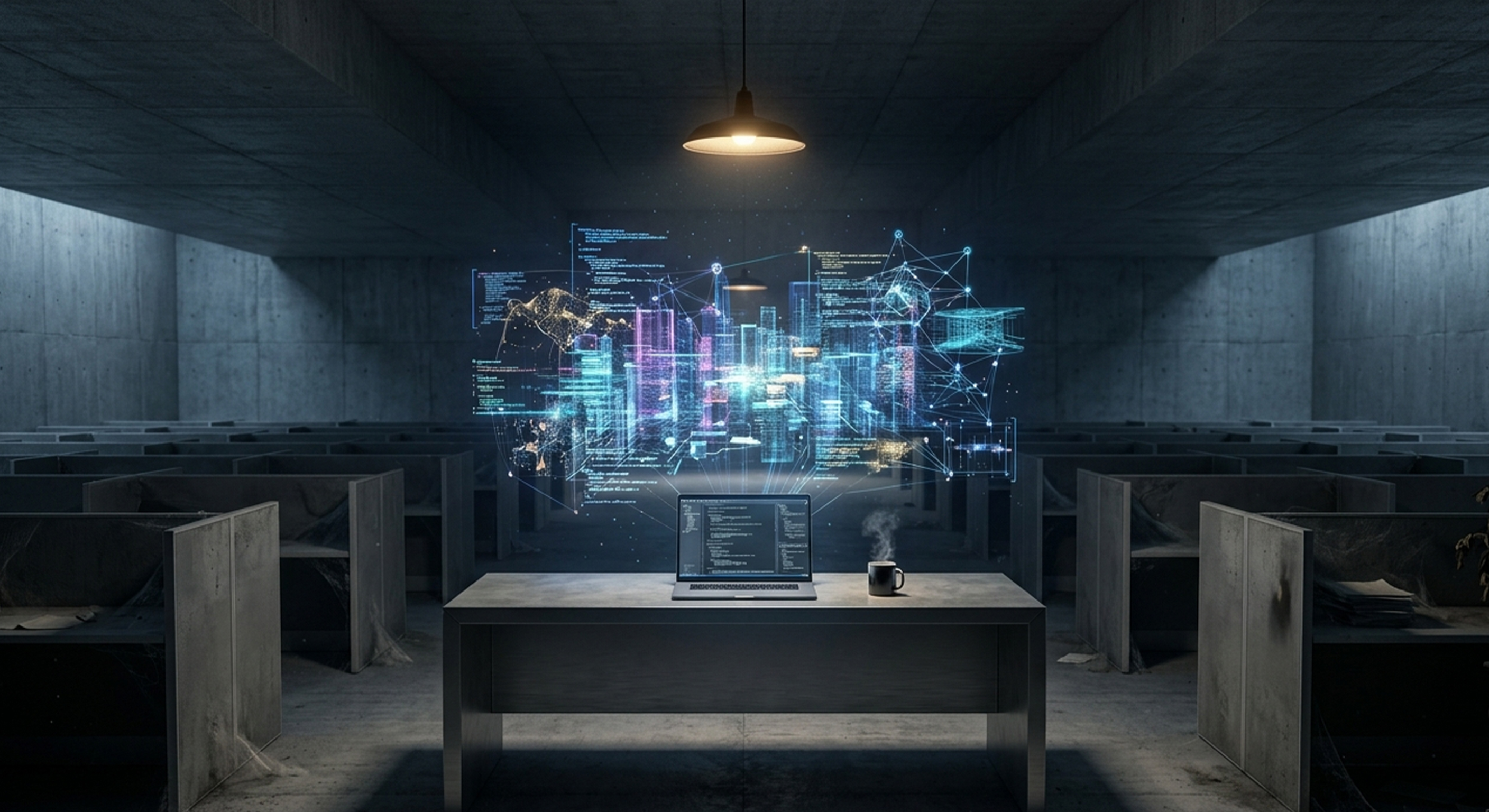
The Invisible Empire
For the entirety of the 20th century, the architecture of commerce was defined by scale. If you wanted to build a company that influenced the market, commanded revenue, or created products with global reach, you were physically required to build an infrastructure of humans. You needed managers, human resource departments, accountants, and dozens of middle-level administrators. The company was not defined by its product; it was defined by its headcount. Success was measured in the number of desks, the square footage of the office, and the complexity of the organizational chart. The individual was expected to be a specialized, replaceable component within this massive, grinding engine.
Then, the digital infrastructure reached a point of critical mass. In the last decade, a silent, radical transformation occurred in how value is generated. The development of sophisticated AI agents, cloud-based automation, and decentralized distribution platforms collapsed the cost of operational scale to near zero. A single individual today has access to the exact same technological capabilities that, twenty years ago, would have required a multimillion-dollar budget and a staff of hundreds. Code can be written by generative models; complex financial logistics can be handled by automated software; marketing and distribution can be orchestrated through global platforms from a single laptop.
The "Solopreneur" is not merely a freelancer or a small business owner. It is a new, structural archetype of labor. The one-person empire functions as a lean, hyper-efficient node in the global economy. By stripping away the bloated layers of corporate hiyerarchy—the endless meetings, the bureaucratic friction, and the political posturing—the solopreneur achieves a velocity that no traditional corporation can ever match. They do not trade time for a salary; they trade their autonomy for the power of the systems they have engineered to operate on their behalf.
This shift represents a fundamental threat to the industrial status quo. The traditional system depends entirely on the dependency of the individual—it needs the worker to trade their agency for a stable paycheck within a cubicle. But the solopreneur paradigm weaponizes technology to create total operational independence. It is the realization that the most dangerous competitor in the modern market is not another massive corporation, but a single human being who has successfully learned how to use the machine to serve their own purpose, rather than becoming a part of the machine themselves.