
Stories in #tech
Editor's Picks
CURATED_STORIES
The Great Greying: How the World Lost Its Color
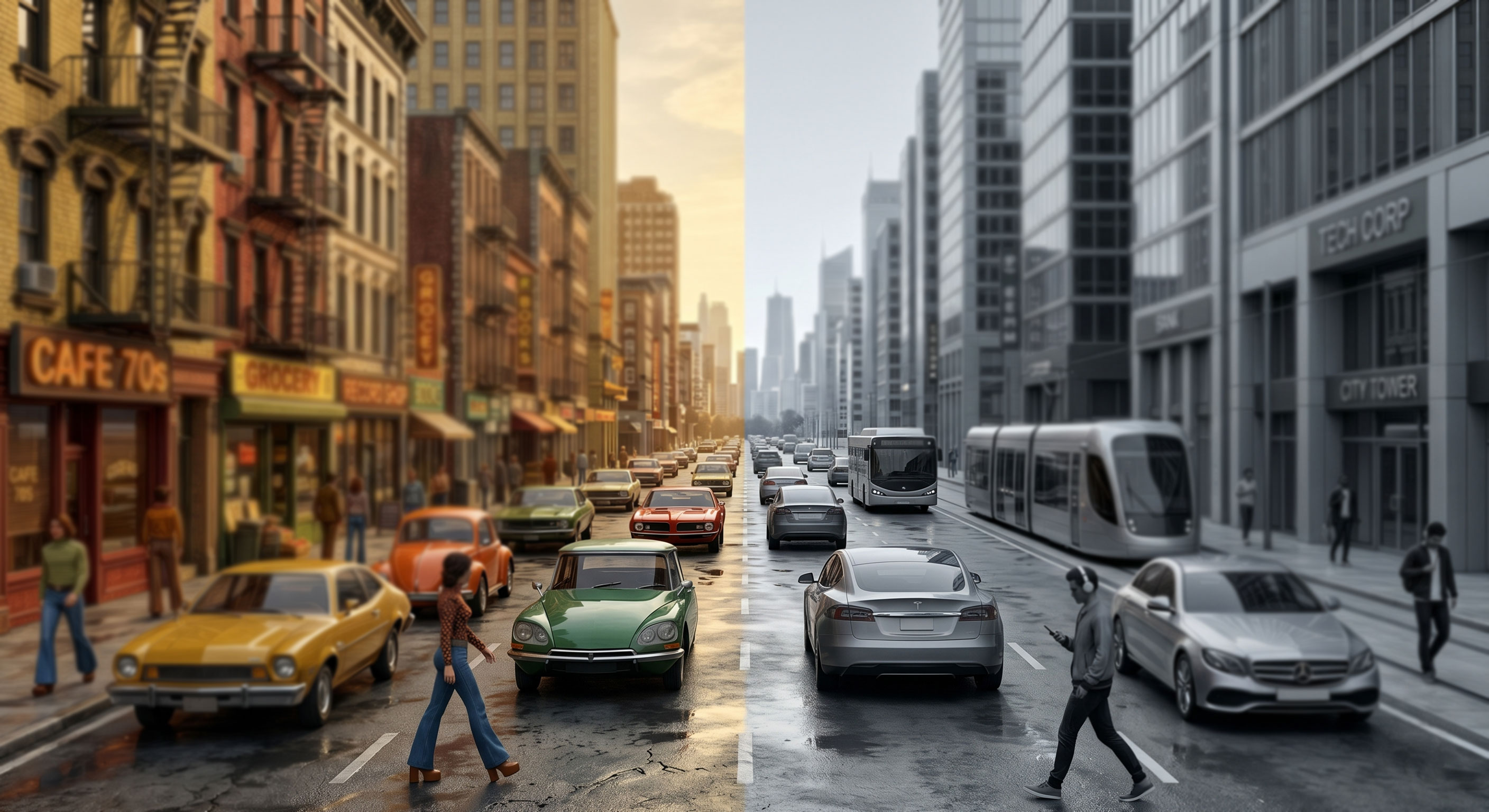
The Fading of the World There is a common psychological phenomenon where people look back at photographs, films, or memories of the mid-20th century and feel an undeniable sense of vibrancy. The past always seems to exist in a spectrum of saturated, heavy colors, while the modern era feels remarkably sterile, cold, and pale. For decades, sociologists and psychologists dismissed this feeling as mere nostalgia—a trick of the human mind romanticizing a bygone era while projecting its own modern depression onto the present. However, a recent, massive computational study proved that human memory was not hallucinating. The physical world is not just feeling colder; it is literally losing its color. In 2020, researchers at the Science Museum Group in the United Kingdom conducted an unprecedented experiment. They utilized an advanced artificial intelligence program to meticulously scan and analyze the color pixels of over 7,000 everyday objects, machines, and artifacts from their vast historical archives. The objects spanned a massive timeline, ranging from the year 1800 to the present day. The resulting data graph was chilling in its absolute linearity. In the 19th and early 20th centuries, the objects that populated human life were a chaotic explosion of warm, vibrant hues—deep woods, rich ceramic reds, mustard yellows, and heavily dyed fabrics. But as the timeline progressed into the late 20th and 21st centuries, those vibrant colors rapidly collapsed. The data proved a massive, systemic plunge towards grayscale. The world had seamlessly replaced organic vibrancy with black, white, silver, and grey. This monochromatic shift is visibly embedded in the very architecture of modern existence. A century ago, city streets were a moving canvas of brightly colored automobiles. Today, global automotive data reveals that nearly eighty percent of all new cars manufactured and sold are exclusively white, black, grey, or silver. The buildings that define modern skylines have stripped away decorative masonry, copper, and painted facades, replacing them with towering monoliths of reflective glass, brushed steel, and exposed brutalist concrete. Even the digital realm mirrors this physical fading. Major corporations and tech monopolies have spent the last decade aggressively "flattening" their logos, systematically stripping away bright colors, shadows, and visual depth in favor of sterile, minimalist, and monochrome typography. The transition from a vibrant, chaotic spectrum to an efficient, uniform grayscale was not an accident. It was the physical manifestation of industrialization and mass production. Silver, black, and white are the default colors of the synthetic materials that built the modern age: plastic, stainless steel, and aluminum. They are the colors of cost efficiency, universal appeal, and safe, inoffensive standardization. The world did not lose its color by chance; it systematically painted over it. The modern human now navigates a deeply engineered, monochromatic landscape, completely surrounded by the cold, metallic palette of the machine.

The Mathematics of Madness: The Dark Story of the Unabomber
The Ghost in the Cabin In the autumn of 1958, a sixteen-year-old boy walked onto the campus of Harvard University. Theodore Kaczynski was not just smart; he was a profound, once-in-a-generation mathematical prodigy with an IQ of 167. He was quiet, awkward, and possessed a mind that operated on a plane of pure, abstract logic. By his mid-twenties, he had earned a Ph.D. from the University of Michigan, solving complex mathematical boundary problems that his own professors could not understand. He was immediately hired as the youngest assistant professor of mathematics in the history of the University of California, Berkeley. His trajectory was flawless. He was destined to be one of the elite architects of the modern world. Then, in 1969, without any warning, Kaczynski abruptly resigned. He packed his belongings, turned his back on academia, and walked away from modern civilization entirely. He purchased a small plot of deeply isolated land in the remote wilderness of Lincoln, Montana. There, he built a tiny, ten-by-twelve-foot wooden cabin by hand. He lived without electricity, without running water, and without a telephone. He grew his own food, hunted with a rifle, and read extensively by the dim light of homemade candles. He sought the absolute, silent purity of nature, attempting to live as an entirely autonomous human being, completely detached from the grinding machinery of the industrial world. For a few years, Kaczynski found his peace. But the modern world does not tolerate a vacuum. Slowly, the industrial system began to encroach upon his isolation. Logging companies began cutting down his surrounding forests. Real estate developers started building roads through the untouched valleys. The deafening roar of jet engines and chainsaws constantly shattered the silence of his refuge. In the summer of 1983, Kaczynski hiked to his favorite, most isolated plateau—a place of pristine beauty—only to find that a massive, paved highway had been bulldozed directly through the center of it. Something inside the brilliant mathematician permanently snapped. He realized that simply running away from the system was impossible; the technological machine would eventually consume everything. He decided that the only way to protect autonomy was to violently destroy the machine. Kaczynski stopped hunting animals and began hunting the architects of the future. Operating out of his primitive, candle-lit cabin, he used scrap wood, match heads, and batteries to engineer devastatingly complex, untraceable explosive devices. Between 1978 and 1995, he mailed these meticulous bombs to universities, airlines, and computer store owners across the United States. He became a ghost, an invisible phantom that paralyzed the nation. The FBI named him the "UNABOMBER" (University and Airline Bomber), launching the longest and most expensive manhunt in American history. For seventeen years, thousands of agents hunted him, utilizing the most advanced forensic technology in the world, yet they found absolutely nothing. He left no fingerprints, no DNA, and no paper trail. The system's most advanced tools were completely useless against a man who used no technology. In 1995, the invisible bomber made a demand. He sent a massive, 35,000-word manifesto titled Industrial Society and Its Future to the national media, promising to stop the bombings if it was published. The manifesto was a meticulously argued, chillingly rational critique of how modern technology and industrialization were systematically destroying human freedom and dignity. The FBI authorized its publication, hoping someone would recognize the writing style. It was a fatal miscalculation for Kaczynski. His own brother, reading the essay in a newspaper, recognized the distinct vocabulary and philosophical arguments. On April 3, 1996, heavily armed federal agents surrounded the tiny, snow-covered cabin in Montana. They did not find a heavily armed militia or a high-tech mastermind. They found an unkempt, disheveled man covered in soot, living in utter squalor, surrounded by bomb-making materials and thousands of pages of encrypted mathematical journals. The genius who had terrified a nation and outsmarted the FBI for nearly two decades was quietly escorted out of the woods, spending the rest of his life locked inside a concrete cell in a supermax prison, watching from a tiny window as the technological world he tried to destroy continued its unstoppable march forward.

The Impossible Machine Found in an Ancient Shipwreck
In the spring of 1900, a crew of Greek sponge divers led by Captain Dimitrios Kondos was sailing through the Aegean Sea when they were suddenly caught in a violent, terrifying storm. Desperate to save their small vessel, they dropped anchor near a barren, rocky island called Antikythera to wait out the turbulent weather. After the storm finally passed, they realized they were anchored in waters they had never explored before. To pass the time, one of the divers, Elias Stadiatis, donned a heavy canvas diving suit and a heavy copper helmet, and was lowered deep into the dark blue water. Minutes later, the crew received frantic tugs on the safety line. They quickly hauled Stadiatis back to the surface. As they removed his copper helmet, they found him pale and hyperventilating, babbling wildly in sheer terror. He claimed that the seafloor was covered with a massive pile of dead, rotting women and dismembered horses. Thinking nitrogen narcosis had driven his diver mad, Captain Kondos suited up and dove into the freezing water himself to see what was down there. When Kondos reached the bottom, roughly 150 feet below the surface, he did not find a graveyard of the dead. He found a massive, ancient Roman shipwreck. The "dead women and horses" Stadiatis had seen were actually breathtaking, life-sized marble and bronze statues scattered across the ocean floor, heavily corroded and covered in centuries of marine growth. The divers had accidentally discovered a treasure ship that had sunk in the first century BC. Over the next year, the crew recovered spectacular artifacts, jewelry, glassware, and coins, delivering them to the National Archaeological Museum in Athens. Among the glittering treasures, they also pulled up an uninteresting, heavily calcified lump of corroded bronze and wood, roughly the size of a shoebox. Because it lacked the beauty of the statues, it was simply placed in a museum courtyard and ignored. Several months later, the dry air caused the calcified lump to crack open. When archaeologist Valerios Stais walked past the fractured rock, he noticed something impossible embedded in the ancient crust: a perfectly formed, precise bronze gear. It would take decades of technological advancement, including high-resolution x-rays and modern 3D CT scans in the 21st century, to fully reveal what was inside that lump of rock. The artifact, now known as the Antikythera Mechanism, was not a simple tool. It was a staggering, hyper-complex analog computer containing over thirty interlocking bronze gears, precise dials, and thousands of microscopic Greek inscriptions acting as a user manual. By turning a hand crank on the side of the wooden box, the gears would calculate and display the exact positions of the sun, the moon, and the five planets known to antiquity. It tracked the lunar phases, predicted solar eclipses down to the specific hour and color, and even accounted for the elliptical orbit of the moon with breathtaking mathematical precision. The true mystery of the Antikythera Mechanism is not just what it does, but the fact that it exists at all. According to everything we know about human history, the metallurgical skill, the astronomical knowledge, and the intricate gear engineering required to build such a device should not have existed in the first century BC. A machine of this terrifying complexity and precision did not appear in the historical record again until the development of astronomical clocks in Europe, a full 1,500 years later. It is an artifact completely out of time, a ghost of advanced technology sitting in a museum case. Who exactly engineered it, how they achieved such impossible precision, and why this incredible knowledge suddenly vanished from the earth, remains completely swallowed by the silence of the sea.
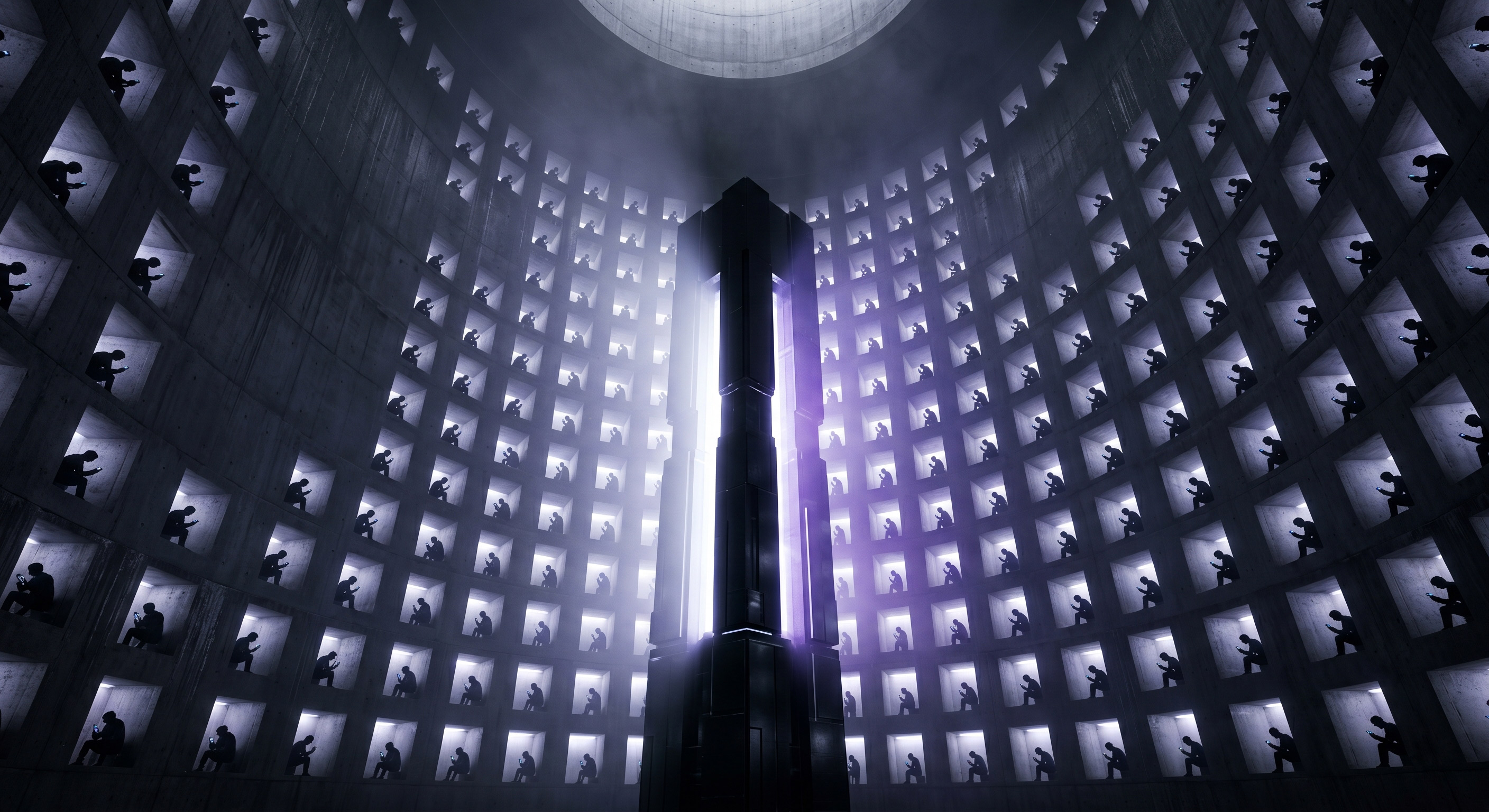
The Digital Panopticon
The Architecture of the Invisible Prison In the late 18th century, the English philosopher Jeremy Bentham designed what he believed to be the ultimate, most efficient architecture of control: a conceptual prison he called the Panopticon. The design was brilliantly simple and deeply terrifying. It consisted of a circular building with individual, backlit cells lining the outer wall. In the absolute center of the circle stood a single, towering guard station. The genius of the Panopticon was in its lighting. Bright lamps were directed outward from the central tower, blinding the prisoners to what was inside. The inmates could never see the guard, but they knew the guard could potentially see any of them at any given moment. The psychological devastation of this design was absolute. Because a prisoner could never know for certain if they were being watched at any specific second, they were forced to assume they were being watched all the time. They had to behave as if the invisible eye was constantly upon them. Bentham realized that physical force was expensive and inefficient. If you create the persistent illusion of total surveillance, you do not need chains, and you do not even need a guard in the tower. The prisoners will eventually internalize the gaze of the authority. Out of pure paranoia, they will regulate their own behavior, suppress their own impulses, and become their own relentless wardens. The architecture of the building effectively destroys the need for physical oppression by turning the human mind into its own cage. Centuries later, the French philosopher Michel Foucault looked at Bentham’s prison and made a horrifying realization: the Panopticon was not just a design for a prison; it was the exact blueprint for modern society. Today, we have willingly built the ultimate global Panopticon, entirely out of code, algorithms, and glowing screens. Social media platforms are the modern circular cells. We voluntarily step inside them, turn the cameras on ourselves, and backlight our own lives for the world to see. But the most terrifying shift in the modern era is that there is no government or dictator sitting in the central tower. The invisible watcher in the center is the Herd. We live in a state of constant, paralyzing self-surveillance. We meticulously curate our words, our photos, and our digital avatars, terrified of the invisible judgment of the anonymous crowd. We suffer from a modern psychological sickness where we preemptively censor our own genuine thoughts, our dark humor, and our unique individual truths just in case the "guard" happens to be looking. The system no longer needs to violently oppress us to ensure conformity. The global herd polices itself through the fear of being canceled, shamed, or ostracized by the phantom crowd. The ultimate tragedy of the digital age is that we celebrate our connectivity and free speech, completely blind to the fact that we have simply become cooperative inmates, happily painting the walls of our own invisible cells. True free will cannot exist while you are constantly performing for the unseen eyes in the tower.
How India Hacked the Global Digital Economy
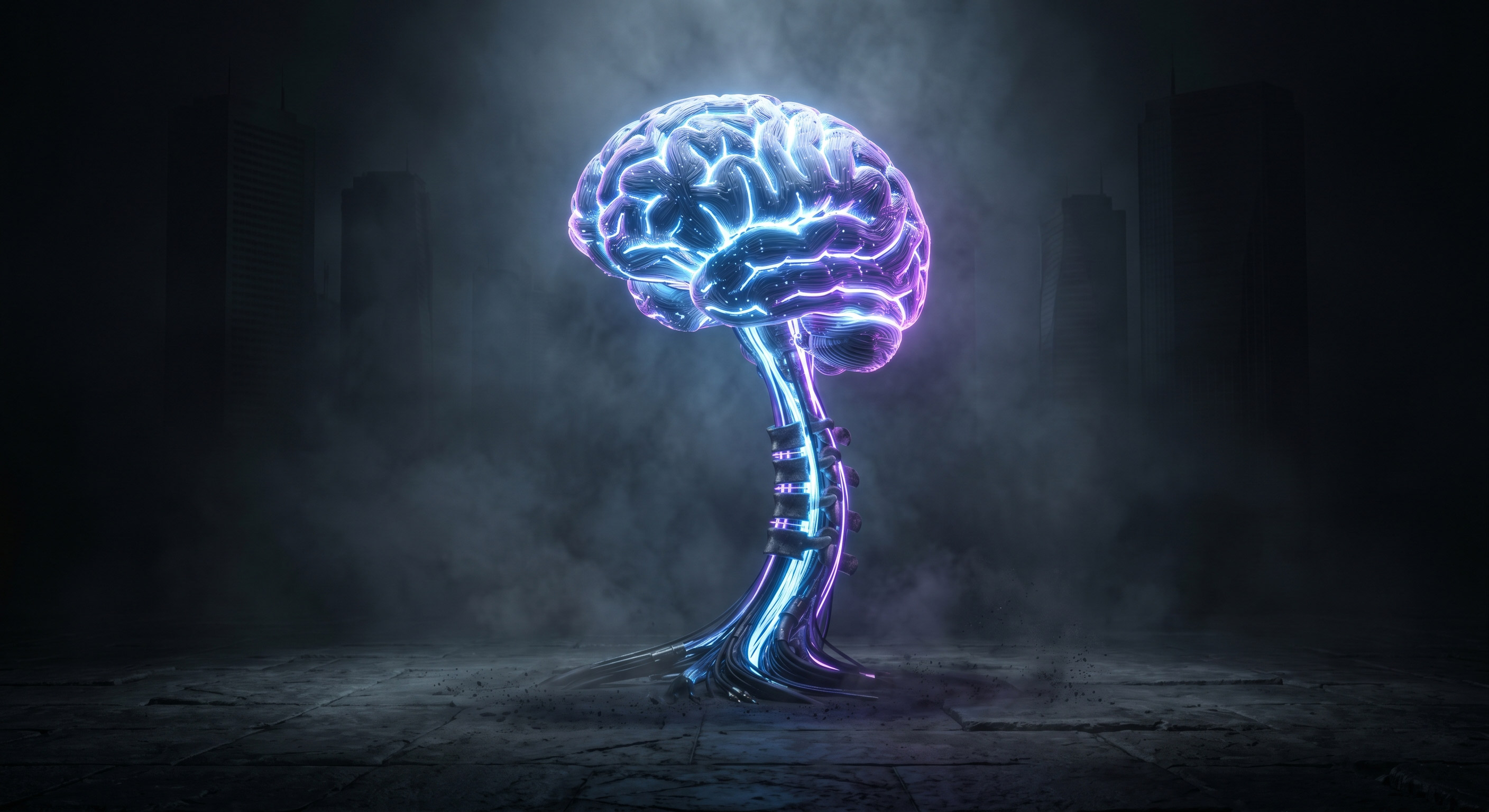
The Architecture of the Global Brain In 1991, the nation of India was standing on the edge of an economic abyss, facing severe bankruptcy and crippled by decades of rigid, bureaucratic isolation. While other developing nations like China were rapidly building massive physical factories to manufacture the world’s plastic goods and electronics, India took a completely different, almost invisible path. They realized that the dawn of the internet and fiber-optic cables was creating a new kind of global demand. The Western world no longer just needed cheap hands to build things; it desperately needed cheap minds to process information. Capitalizing on a massive, highly educated, English-speaking population, India aggressively positioned itself not as the workshop of the world, but as its global back office. The initial strategy was built on executing the digital grunt work of the West. When the global panic of the Y2K computer bug hit in the late 1990s, Western corporations desperately outsourced the tedious task of checking millions of lines of code to Indian programmers. This opened the floodgates. Soon, customer service calls, data entry, and software maintenance for the world's biggest corporations were all silently routed through massive tech hubs in cities like Bengaluru. The global elite thought they had simply found a clever loophole to cut cognitive labor costs by eighty percent. However, they failed to realize that by outsourcing their digital infrastructure, they were inadvertently handing over the blueprints of the modern economy. Over the next twenty years, a fascinating systemic shift occurred. The Indian workforce did not remain at the bottom of the digital hierarchy. They absorbed the knowledge, mastered the corporate architecture, and began building their own massive global tech empires. The generation that started out answering IT support calls evolved into the engineers designing the core algorithms of the future. Today, it is no coincidence that the CEOs of some of the most powerful tech monopolies on the planet—including Google and Microsoft—are of Indian descent. What began as a desperate attempt to survive bankruptcy turned into a silent, masterful takeover of the global digital nervous system. India essentially hacked the global economy by making themselves the indispensable cognitive engine of the modern world. However, beneath the surface of this celebrated "economic miracle" lies a profound philosophical tragedy regarding human autonomy. The entire model of this explosive growth was built on standardizing the human mind to perfectly serve foreign corporate algorithms. The system took millions of brilliant, individual minds and molded them into highly efficient, deeply obedient processors for the global hive. We celebrate this massive economic growth as a victory, yet we rarely question the terrifying psychological cost of a society where success is entirely defined by how perfectly a human being can function as a cog in an invisible, digital machine. The illusion of modern progress is that a nation can break free from poverty, only to willingly lock its people inside a gilded, digital cage built by someone else.

The Dead Internet Theory
The Phantom Crowd In the early days of the digital frontier, the internet was a raw, chaotic, and profoundly human space. It was a chaotic network of personal blogs, messy forums, and unfiltered human consciousness connecting across continents. However, a chilling hypothesis known as the "Dead Internet Theory" suggests that this era has quietly ended, and the bustling digital metropolis we believe we are navigating today is actually a sophisticated ghost town. According to this theory, sometime in the late 2010s, organic human activity was overtaken by artificial intelligence, automated bots, and algorithmic content farms. The terrifying premise is that the majority of the posts, comments, trending hashtags, and online arguments we see are no longer generated by living, breathing people, but by vast networks of code programmed to endlessly talk to one another. The mechanics of this phantom takeover are entirely driven by the modern economy of attention. Social media platforms do not prioritize truth or authentic human connection; their primary objective is to keep users endlessly scrolling. To achieve this, it became vastly more efficient to automate content generation. Bot networks are deployed to scrape old images, rewrite past viral thoughts, and generate artificial outrage. When a controversial post goes viral, the thousands of furious comments underneath it are often just opposing algorithms programmed to simulate human conflict, artificially inflating engagement metrics. We are witnessing a synthetic loop where bots generate content, other bots react to it, and algorithms promote the resulting noise to the top of our feeds. The internet has transformed from a tool of human communication into a closed-circuit mirror, reflecting a manufactured reality. What makes this invisible architecture so dangerous is how effortlessly it exploits human psychology. As social creatures, we are biologically wired to look to the crowd to understand our reality, gauge societal norms, and seek validation. But when the crowd is a phantom, our perception of reality is quietly hijacked. People are modifying their genuine beliefs, self-censoring, and feeling profound isolation based on the artificial consensus of machines. The modern herd is desperately performing for an audience of empty code, sacrificing their authentic voices to gain the approval of algorithms that cannot feel, care, or understand. The ultimate tragedy of the modern era is that we are dying of thirst while drowning in an ocean of synthetic connection. We type our deepest fears and greatest ambitions into glowing rectangles, hoping for a human echo, only to receive a mathematically optimized simulation of empathy or outrage. To reclaim true individuality in this algorithmic age requires a radical shift in perspective. It demands that we stop seeking validation from a digital crowd that does not exist. True freedom begins the moment you realize that the overwhelming roar of the internet is mostly just the sound of a machine humming in the dark, and the only voice that truly matters is the one you cultivate in the quiet of reality.