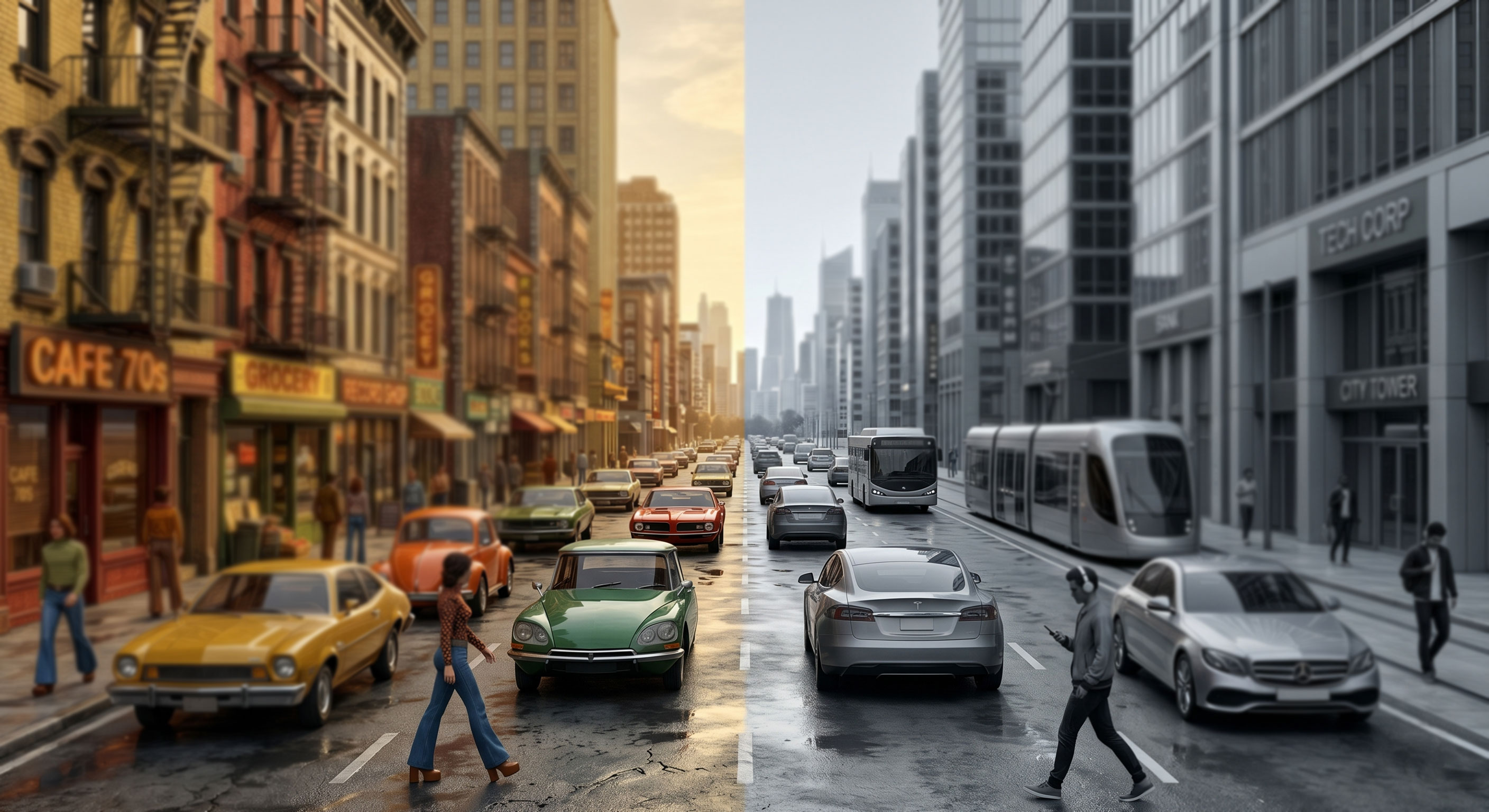
The Fading of the World
There is a common psychological phenomenon where people look back at photographs, films, or memories of the mid-20th century and feel an undeniable sense of vibrancy. The past always seems to exist in a spectrum of saturated, heavy colors, while the modern era feels remarkably sterile, cold, and pale. For decades, sociologists and psychologists dismissed this feeling as mere nostalgia—a trick of the human mind romanticizing a bygone era while projecting its own modern depression onto the present. However, a recent, massive computational study proved that human memory was not hallucinating. The physical world is not just feeling colder; it is literally losing its color.
In 2020, researchers at the Science Museum Group in the United Kingdom conducted an unprecedented experiment. They utilized an advanced artificial intelligence program to meticulously scan and analyze the color pixels of over 7,000 everyday objects, machines, and artifacts from their vast historical archives. The objects spanned a massive timeline, ranging from the year 1800 to the present day. The resulting data graph was chilling in its absolute linearity. In the 19th and early 20th centuries, the objects that populated human life were a chaotic explosion of warm, vibrant hues—deep woods, rich ceramic reds, mustard yellows, and heavily dyed fabrics. But as the timeline progressed into the late 20th and 21st centuries, those vibrant colors rapidly collapsed. The data proved a massive, systemic plunge towards grayscale. The world had seamlessly replaced organic vibrancy with black, white, silver, and grey.
This monochromatic shift is visibly embedded in the very architecture of modern existence. A century ago, city streets were a moving canvas of brightly colored automobiles. Today, global automotive data reveals that nearly eighty percent of all new cars manufactured and sold are exclusively white, black, grey, or silver. The buildings that define modern skylines have stripped away decorative masonry, copper, and painted facades, replacing them with towering monoliths of reflective glass, brushed steel, and exposed brutalist concrete. Even the digital realm mirrors this physical fading. Major corporations and tech monopolies have spent the last decade aggressively "flattening" their logos, systematically stripping away bright colors, shadows, and visual depth in favor of sterile, minimalist, and monochrome typography.
The transition from a vibrant, chaotic spectrum to an efficient, uniform grayscale was not an accident. It was the physical manifestation of industrialization and mass production. Silver, black, and white are the default colors of the synthetic materials that built the modern age: plastic, stainless steel, and aluminum. They are the colors of cost efficiency, universal appeal, and safe, inoffensive standardization. The world did not lose its color by chance; it systematically painted over it. The modern human now navigates a deeply engineered, monochromatic landscape, completely surrounded by the cold, metallic palette of the machine.