A Scream From the Void
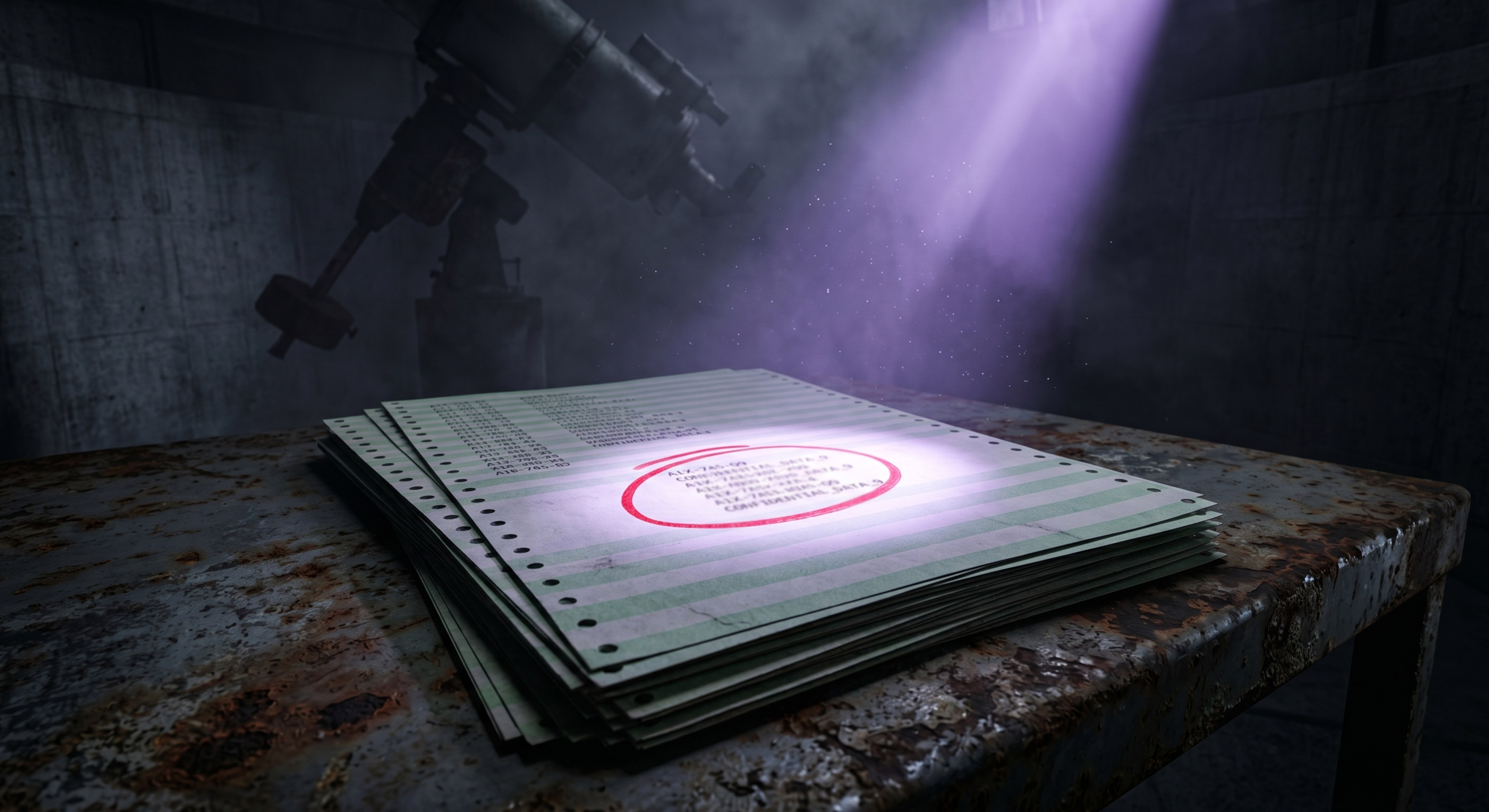
In the late summer of 1977, the Big Ear radio telescope in Delaware, Ohio, was quietly scanning the darkest reaches of the cosmos. It was a massive, flat structure the size of three football fields, designed not to look at the stars, but to listen to them. For years, it had recorded nothing but the low, steady, chaotic static of the universe—the dying breath of stars and the microwave background radiation of the cosmos. The data was continuously fed into an IBM mainframe, which printed the radio intensity on endless stacks of green-and-white perforated paper using a simple alphanumeric code.
On August 15, a volunteer astronomer named Jerry Ehman was reviewing the recent stack of computer printouts. His eyes scanned the columns of low numbers—ones, twos, and threes, representing the normal, quiet background noise of space. Suddenly, in a column tracking a region of sky near the constellation Sagittarius, the numbers spiked violently. The sequence read: 6EQUJ5. In the specific coding system of the observatory, this sequence represented an incredibly massive, concentrated burst of radio energy. It was exactly thirty times louder than the deep space vacuum.
Ehman was so stunned by the sheer impossibility of the data that he grabbed a red pen, circled the sequence, and scribbled a single word in the margin: "Wow!"
The physical characteristics of the signal were chillingly precise. The transmission lasted for exactly 72 seconds. This was not a random duration; it was the exact maximum amount of time the fixed Big Ear telescope could physically observe a single point in the sky as the Earth rotated. Furthermore, the signal was broadcast at exactly 1420 Megahertz. This is the precise resonant frequency of hydrogen, the most abundant element in the universe. Long before 1977, theoretical physicists had established that if an intelligent civilization were trying to communicate across the cosmic void, they would use 1420 Megahertz as a universal, mathematical baseline.
The scientific community immediately mobilized to find the source. Over the next few decades, the most powerful radio telescopes on the planet were pointed at that exact patch of empty space in Sagittarius. They listened for months, then years, waiting for the transmission to repeat. But the cosmos remained entirely silent. There was absolutely no trace of a satellite malfunction, no terrestrial interference, and no natural cosmic phenomenon that could explain the sheer strength and precision of the broadcast. It was a single, deafening, highly structured roar from 200 light-years away, and then, absolute silence. To this day, the origin of the signal remains completely unknown.