The Eras of the Mind
In 1964, a British director named Michael Apted began a uniquely ambitious cinematic experiment that was originally intended to be a simple sociological study of class structure. He selected a group of fourteen seven-year-old children from vastly different socioeconomic backgrounds across Britain. His premise was straightforward: point a camera at them, ask them about their lives, their fears, and their dreams, and then return to film them again every seven years. The project, which started with the film 7 Up and culminated decades later, accidentally captured something far more profound and unsettling than the British class system. By watching human beings age in rapid, episodic intervals, the documentary revealed a haunting truth about identity. The children growing into teenagers, adults, and the elderly did not appear as the same individuals simply acquiring more time. They looked and behaved like a sequence of entirely different strangers occupying the same name.
For centuries, human culture and law have relied on arbitrary, comforting numbers to define the chapters of our existence. Society declares that adulthood begins precisely at eighteen, formal education is expected to conclude in the early twenties, and the midpoint of life is casually accepted as thirty-five. We cling to the reassuring illusion that we possess a continuous, unbroken "self" that merely accumulates memories and experiences along a smooth, linear timeline. However, recent structural science has shattered this illusion entirely, proving that Apted’s camera was capturing a brutal, underlying biological reality.
Researchers at Cambridge University recently mapped the structural evolution of the human brain across a massive dataset of individuals, seeking to understand the physical mechanics of aging. They did not find a slow, steady decline or a gradual, continuous maturation. Instead, the data revealed that the human brain undergoes massive, abrupt, and systemic structural rewiring at four highly specific ages: 9, 32, 66, and 83.
At age nine, the child’s brain undergoes a profound architectural collapse and rebuilding. The vast, chaotic overabundance of neural connections formed during early childhood—the exact networks that create a child's boundless, unfiltered imagination—are ruthlessly pruned. The brain biologically shuts down the endless possibilities of childhood to install a more efficient, focused network designed for social survival and complex logic. The child you were biologically ceases to exist, making way for the adolescent.
The second violent rewiring occurs at age thirty-two. The brain permanently hardens its structure, physically locking in habits, emotional baselines, and cognitive patterns. The neurological fluidity and adaptability of youth are biologically cemented into a fixed adult architecture. Decades later, at sixty-six, the brain undergoes another massive systemic shift, stepping away from the aggressive cognitive processing of mid-life into a completely different mode of operating. Finally, at eighty-three, the network completely reorganizes itself one last time for the final biological chapter.
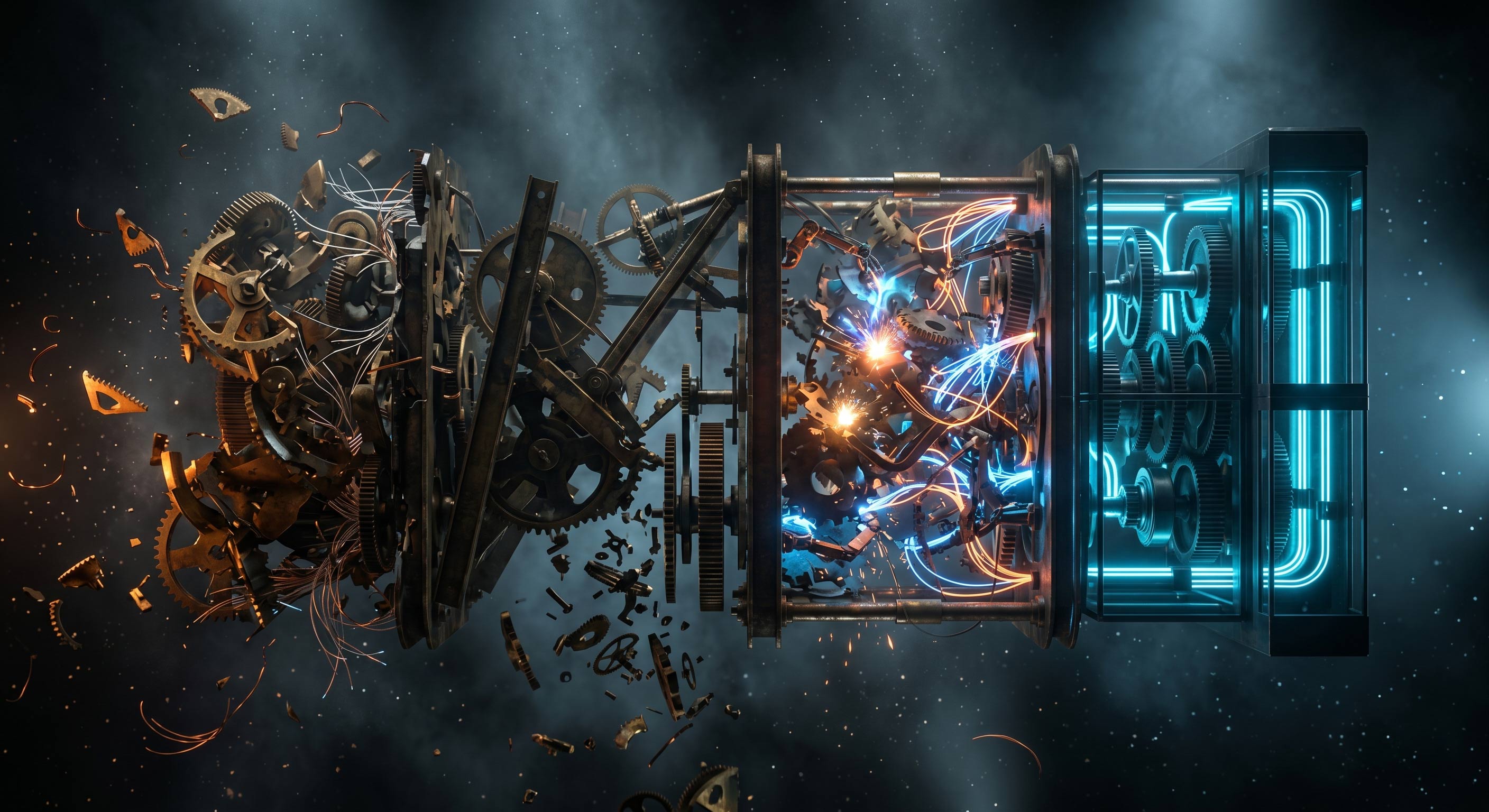
The terrifying poetry of this science is that you do not actually live one continuous life. Your physical existence is divided into five distinct biological eras, separated by four neurological deaths. At 9, 32, 66, and 83, the physical architecture of the person you were is systematically demolished to build the person you must become next. The human identity is not a permanent statue carved from stone; it is simply a biological machine that periodically reboots and rewrites its own operating system, leaving the ghosts of your past selves trapped entirely in the past.