In the spring of 1900, a crew of Greek sponge divers led by Captain Dimitrios Kondos was sailing through the Aegean Sea when they were suddenly caught in a violent, terrifying storm. Desperate to save their small vessel, they dropped anchor near a barren, rocky island called Antikythera to wait out the turbulent weather. After the storm finally passed, they realized they were anchored in waters they had never explored before. To pass the time, one of the divers, Elias Stadiatis, donned a heavy canvas diving suit and a heavy copper helmet, and was lowered deep into the dark blue water.
Minutes later, the crew received frantic tugs on the safety line. They quickly hauled Stadiatis back to the surface. As they removed his copper helmet, they found him pale and hyperventilating, babbling wildly in sheer terror. He claimed that the seafloor was covered with a massive pile of dead, rotting women and dismembered horses. Thinking nitrogen narcosis had driven his diver mad, Captain Kondos suited up and dove into the freezing water himself to see what was down there.
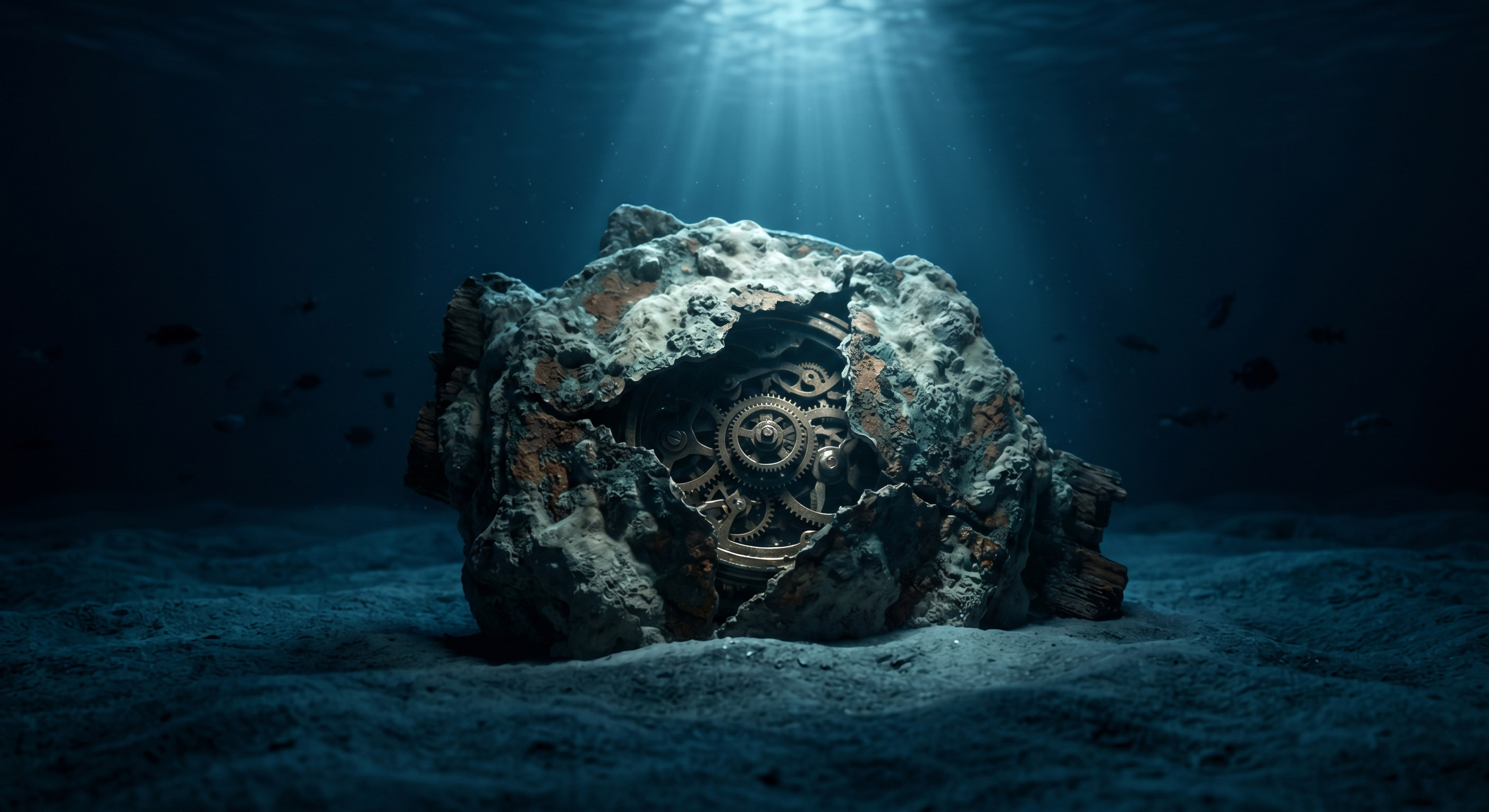
When Kondos reached the bottom, roughly 150 feet below the surface, he did not find a graveyard of the dead. He found a massive, ancient Roman shipwreck. The "dead women and horses" Stadiatis had seen were actually breathtaking, life-sized marble and bronze statues scattered across the ocean floor, heavily corroded and covered in centuries of marine growth. The divers had accidentally discovered a treasure ship that had sunk in the first century BC. Over the next year, the crew recovered spectacular artifacts, jewelry, glassware, and coins, delivering them to the National Archaeological Museum in Athens. Among the glittering treasures, they also pulled up an uninteresting, heavily calcified lump of corroded bronze and wood, roughly the size of a shoebox. Because it lacked the beauty of the statues, it was simply placed in a museum courtyard and ignored.
Several months later, the dry air caused the calcified lump to crack open. When archaeologist Valerios Stais walked past the fractured rock, he noticed something impossible embedded in the ancient crust: a perfectly formed, precise bronze gear.
It would take decades of technological advancement, including high-resolution x-rays and modern 3D CT scans in the 21st century, to fully reveal what was inside that lump of rock. The artifact, now known as the Antikythera Mechanism, was not a simple tool. It was a staggering, hyper-complex analog computer containing over thirty interlocking bronze gears, precise dials, and thousands of microscopic Greek inscriptions acting as a user manual. By turning a hand crank on the side of the wooden box, the gears would calculate and display the exact positions of the sun, the moon, and the five planets known to antiquity. It tracked the lunar phases, predicted solar eclipses down to the specific hour and color, and even accounted for the elliptical orbit of the moon with breathtaking mathematical precision.
The true mystery of the Antikythera Mechanism is not just what it does, but the fact that it exists at all. According to everything we know about human history, the metallurgical skill, the astronomical knowledge, and the intricate gear engineering required to build such a device should not have existed in the first century BC. A machine of this terrifying complexity and precision did not appear in the historical record again until the development of astronomical clocks in Europe, a full 1,500 years later. It is an artifact completely out of time, a ghost of advanced technology sitting in a museum case. Who exactly engineered it, how they achieved such impossible precision, and why this incredible knowledge suddenly vanished from the earth, remains completely swallowed by the silence of the sea.