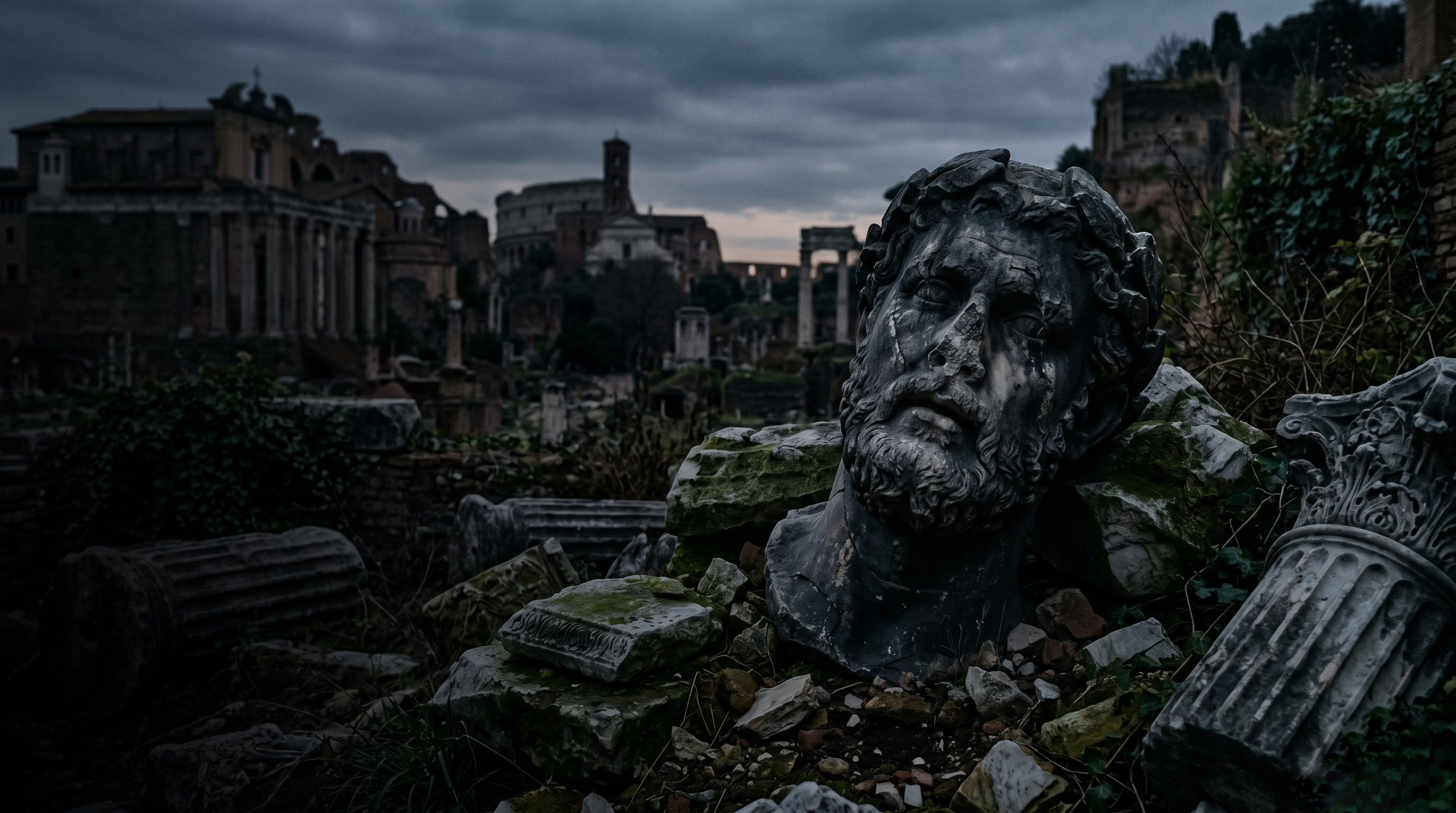
Collapse or Transformation? How an Empire Creates Its Own Demise
History books often tell us that the Roman Empire was destroyed by "barbarian armies." However, massive systems do not collapse from a single sword strike from the outside; they rot from the inside first, then scatter with a gentle breeze from the outside. The story of Rome is not so much a bloody invasion as it is the silent exhaustion of a bureaucratic apparatus crushed under its own weight and a weary civilization.
So, why did this colossal mechanism, which transcended its era with its army, laws, and culture, grind to a halt?
The Butterfly Effect from the Steppes and the Domino Stone
The climatic fluctuations and droughts that began in the Asian steppes in the late fourth century dried up not only the pastures but also world history. The Hun cavalry, heading west to survive, pushed every community in their path into the heart of Europe like falling dominoes.
This massive movement stretching from the Caspian to the Danube was not a simple "invasion"; it was an economic and ecological necessity triggered by the instinct to survive. Rome's borders were no longer just a military line, but a center of attraction for masses fleeing hunger and uncertainty. The Empire made a historical mistake in this crisis: Instead of fighting this flood of humanity at its borders, it hired them as mercenaries into its own army under the name "Foederati" (allied soldiers). Rome had outsourced the job of protecting its own borders to those coming from beyond them.
The Rot of the Center and Bureaucratic Paralysis
While this domino effect was happening outside, Rome had long been paralyzed on the inside. The state apparatus had grown so massive and cumbersome that collecting taxes and keeping the system alive became more important than the welfare of the people.
Small farmers, crushed under heavy taxes, abandoned their lands to wealthy aristocrats and became enslaved (the colonus system), irreversibly severing the sacred bond of "trust" between the state and the citizen. Citizens no longer saw the state as a protector, but as a parasite on their backs. The army, on the other hand, had turned into local mafias loyal to their own generals, fighting not out of patriotism but solely for the motivation of payday. The moment the system stopped expanding, it began to consume itself.
The "Barbarian" Illusion: Who Does the System Blame?
Perhaps the greatest legacy Rome left to history is the invention of the "Other" (Barbarian) as a tool of political manipulation. While the word "barbarian" originally just described those who spoke a different language, it was eventually used to stigmatize anyone who did not fit into or could not be tamed by the system.
Because the Empire could not explain the internal corruption, economic collapse, and moral degradation to the public, it blamed everything on the "barbarians" beyond the border. Yet, those Goths and Vandals they called barbarians were people who had served as generals in the Roman army for years, spoke Latin, and even believed in the same God. The barbarian image was actually a scapegoat created by a collapsing system to soothe its own conscience. As the system lost its own virtue, it had to inflate the image of the barbarian.
Fragile Peace and the Postponed Apocalypse
By the fifth century, Rome still seemed to be breathing, but it was the breath of a comatose patient on life support. In the palace at Ravenna, emperors ruled only on paper, while the real power was held behind the scenes by generals and bureaucrats.
Politics was no longer practiced to solve problems, but to postpone conflicts through bribery, concessions, and diplomatic games. When external threats approached, a fake internal unity was formed; when the threat receded, everyone chased their own personal gain. Rome was not experiencing a peaceful era without war, but a stagnation where the apocalypse was constantly delayed.
Collapse or Transformation? The Redistribution of Energy
So, did Rome really fall? Classical history tells this as a tragic end. In reality, what happened was not a "destruction," but a massive transformation and the redistribution of historical energy.
The physical state apparatus collapsed, but the spirit of Rome lived on. The newly established Germanic kingdoms (Visigoths, Vandals, Ostrogoths) adopted Roman law, the tax system, architecture, and church organization exactly as they were. In other words, although the Empire lost its worldly borders, it managed to bequeath its mental and cultural codes to all of Europe.
Even today, the governance, law, and bureaucracy of the modern world rise upon the ruins of that supposedly fallen Rome. History whispers this to us: A true idea never dies even if the institutions that carry it are destroyed; it merely changes form.