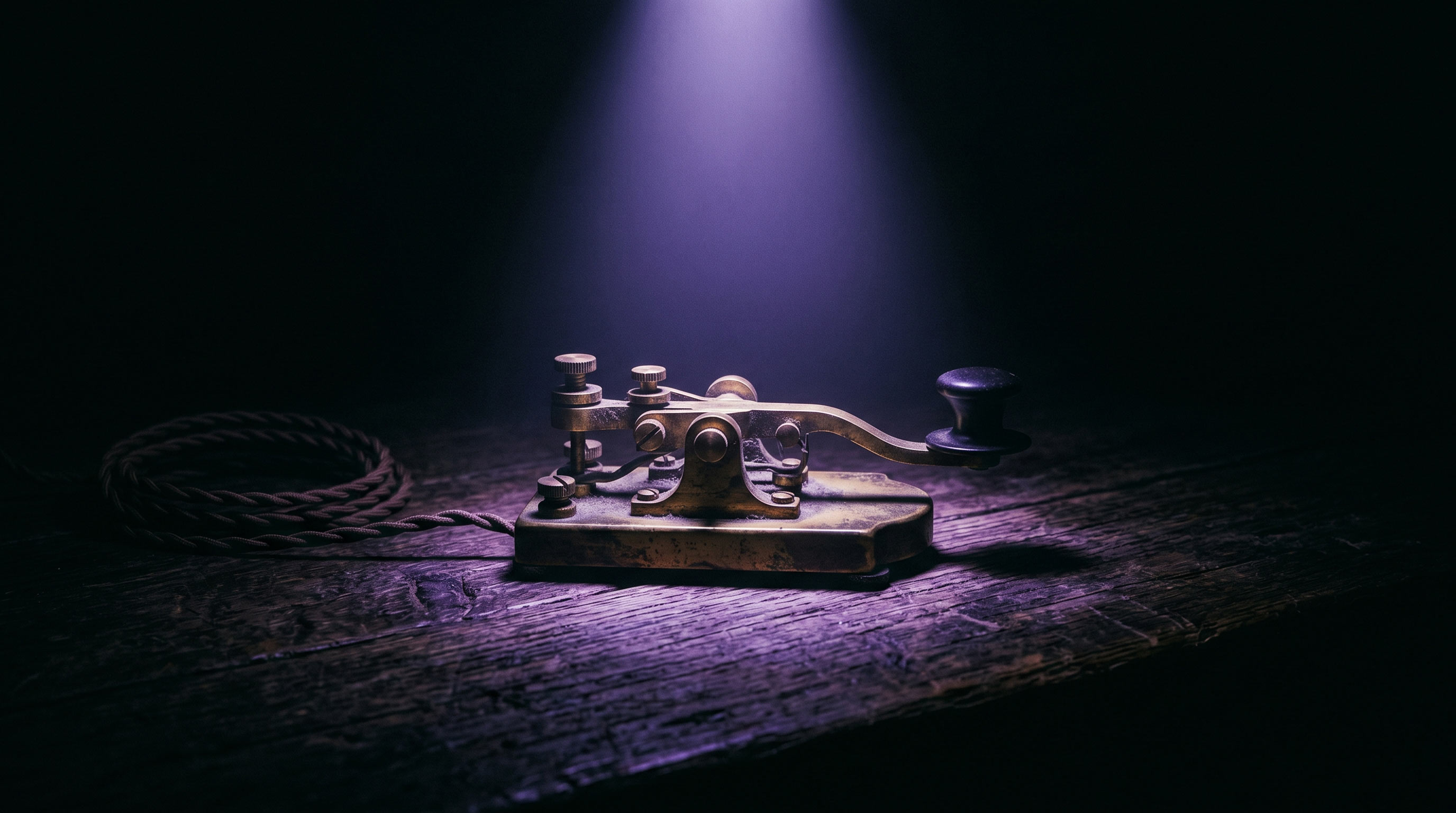
The Shocking and Serendipitous Invention of Morse Code
Shortly after the Battle of Balaclava in 1855—an event that skyrocketed Florence Nightingale's fame but failed to decisively end the Crimean War—Samuel Morse confidently announced an invention that he believed would foster global friendship and ultimately put an end to warfare. By 1858, the very first transatlantic telegraph message traversed the freezing depths of the Atlantic Ocean, connecting New York and London. The journey to lay this underwater cable was nothing short of an epic saga, enduring three separate sea expeditions, two snapped cables, and even interference from a seemingly anti-technology whale.
The public was utterly mesmerized by this new telegraph technology. Tiffany & Co. capitalized on the craze by purchasing leftover, unlaid cables and selling them as commemorative souvenirs. Some sections of the cable were even repurposed to make umbrellas. People in both America and Britain were highly optimistic; they genuinely believed that with a tool allowing instantaneous exchange of thoughts between nations, old prejudices and hostilities would simply vanish. The creators of this marvel were showered with praise.
Yet, the quest for a rapid communication machine had actually been ongoing for nearly a century. The French, for instance, had constructed an odd optical system comprising metal contraptions mounted on towers, synchronized clocks, and line-of-sight visual relays. However, they soon realized that despite the famous French fog and rain, their enemies could visually intercept and read these military messages. Consequently, Napoleon ordered the system to be dismantled, even though this optical telegraph had been a key factor in his armies' rapid successes by providing faster communication than traditional couriers.
Some early pioneers speculated that electricity might be the answer, but the scientific understanding of the time was comically primitive. Back in the 1750s, Benjamin Franklin entertained his dinner guests by using electricity to slaughter the turkeys and chickens he was about to serve. Around the same era, the scientist Jean-Antoine Nollet conducted a bizarre experiment to measure the "speed" of electricity. He lined up about two hundred volunteer priests in a sunlit field, spanning a mile, and had them hold pieces of connecting wire. When he sent a massive electric shock down the line, all the priests simultaneously leaped into the air, shouting decidedly unholy curses. This synchronized jumping convinced Nollet that electricity traveled at an infinite speed, slowly setting the historical stage for the telegraph.
Meanwhile, Samuel Morse's original ambition was simply to be a painter. During a trip to Europe in 1812 to refine his art, he ended up absolutely despising Europeans. Furthermore, when Americans failed to appreciate his reproductions of famous European paintings, he bitterly claimed his art wouldn't be understood for at least another hundred years.
It was during another return voyage from Europe in 1832 that Morse mistakenly believed he had single-handedly invented the electric telegraph. Blissfully unaware that brilliant scientists had been agonizing over this exact problem for over a century, Morse naively thought the only missing piece of the puzzle was figuring out how to code the messages. Ignorance, in this case, was a blessing; had he known the daunting technical hurdles of inventing the telegraph hardware, he might have been too discouraged to ever create his famous code.
Indeed, no one else had yet devised a truly practical coding system. Previous telegraph concepts relied on multiple cumbersome wires triggering specific clocks or indicating individual letters, which was painfully slow and inefficient. Morse's code, however, would go on to change the entire world.
The brilliance of Morse's system lay in its extreme simplicity: it used only two symbols, a dot and a dash. In the original Morse code, numbers were straightforward: one dot meant 1, two dots meant 2, and so on up to 5, which transitioned into a dash. He originally assigned a specific number to every single word. Morse actually wanted these codes for English words to be treated as a matter of national security, fiercely protected by the American government. Fortunately, his colleagues proposed a much more practical approach: assigning a unique code to each individual letter instead of cataloging whole words. Even today, historians claim that it was Morse's assistant, Alfred Vail, who was truly responsible for this groundbreaking and necessary modification.
As for that monumental, world-changing first transatlantic message in 1858? It was merely a mundane administrative note canceling an order of British military supplies bound for Canada. Shortly after that transmission, the fragile underwater cable broke and was rendered completely useless. And those grand, optimistic predictions of enduring world peace driven by communication were entirely shattered less than three years later by the brutal outbreak of the American Civil War.