In the darkest, bloodiest years of the 1940s, the American public desperately needed a reason to smile. Surprisingly, this hope did not arrive in the form of a decorated general or a battlefield victory, but rather as a quiet, dress-wearing squirrel. When humanity is plunged into the terrifying abyss of global war, it tends to anchor its sanity to the most bizarre and innocent anomalies it can find.
This is the story of Tommy Tucker, a creature who never knew he was a national hero.
The Fall and The Surrogate Mother
The saga began on a pleasant afternoon in 1942, when a blind, hairless baby squirrel tumbled out of a tree and landed in the backyard of the Bullis family. With his mother presumably dead and having abandoned him to fate, the tiny orphan's life was saved by Zaidee Bullis, a childless housewife. When Zaidee scooped up the fragile creature, she didn't just adopt a pet; she found the child she never had.
Tommy was bottle-fed, bathed regularly, and tucked into a miniature bed. But Zaidee’s ultimate expression of affection was her obsession with his wardrobe. Over time, Tommy amassed a custom-tailored collection of between thirty and a hundred outfits. He wore a coat and hat for trips to the market, a pleated silk dress for entertaining houseguests, and a custom Red Cross uniform for visiting hospitals. Though Tommy was biologically male, his magnificent, bushy tail made wearing pants impossible, dictating that his entire wardrobe consist exclusively of women's dresses.
A Mute Celebrity in a Loud World
By 1944, Tommy’s surreal existence caught the attention of LIFE magazine, immortalized through the lens of photographer Nina Leen. The publication melancholically noted that he was a tame, tranquil squirrel who never had the opportunity to leap through the canopies of great trees. While most trained squirrels love to perform frantic tricks for an audience, Tommy defied this expectation. He captivated people not with acrobatics, but with an eerie quietness and an odd, unnatural elegance.
Carried delicately on Zaidee’s arm, the cross-dressing squirrel became a famous fixture in Washington, frequenting bakeries, florists, and markets. He toured schools and brought smiles to the faces of children in hospital wards. The illusion of his humanity was pushed so far that Zaidee even typed up an "autobiography," allegedly narrated by the squirrel himself.
Selling Bonds in Satin
As the chaos of the Second World War escalated, the U.S. government realized that citizens would open their wallets for anything that offered a brief escape from reality. Tommy's fame transcended city limits, prompting the U.S. Treasury Department to build him a specialized viewing stand. Draped in red, white, and blue satin, the squirrel became a living propaganda tool, helping to sell war bonds to fund the military.
He "co-hosted" radio broadcasts alongside President Franklin D. Roosevelt's announcements. The absurdity reached its peak on the front lines. A Treasury official wrote a letter detailing how bomber crews were pinning photographs of Tommy inside their cockpits. In their letters home, soldiers confessed that looking at a picture of a squirrel in a dress somehow lifted their shattered morale amidst the horrors of combat. At the height of his fame, the Tommy Tucker Club boasted 30,000 members, making him the most famous rodent in America, second only to Mickey Mouse.
The Final Outfit
When the war ended, the nation's frantic need for Tommy's brand of escapism faded. He stopped his nationwide tours, though he still traveled with the Bullis couple in a trailer hitched to their Packard automobile, which hauled his massive wardrobe. He even found companionship with another squirrel named Buzzy.
In 1949, during a trip to the Grand Canyon, Tommy passed away in his trailer; his cause of death was recorded as a heart attack due to old age. But Zaidee couldn't let go. The family took his body to an Arizona taxidermist, requesting that his arms be permanently mounted in an open position so they could continue to dress him in his outfits even after death.
After the Bullis family passed away, Tommy’s stuffed remains, his extensive wardrobe, photographs, and fan mail from children were inherited by a relative. In 2005, the bizarre collection was offered to the Smithsonian Institution, which initially rejected it before finally accepting it into their archives in 2012.
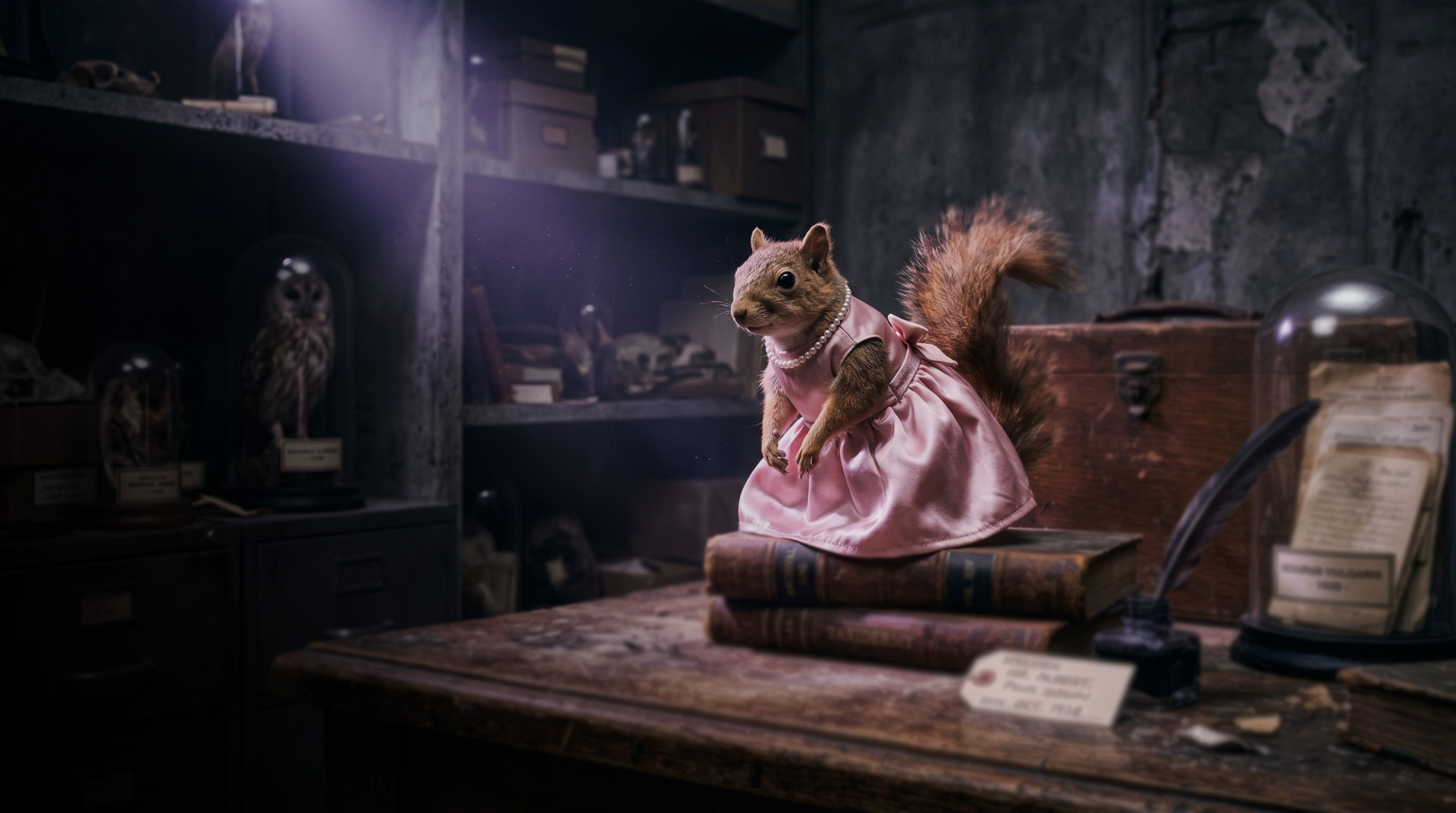
Today, Tommy Tucker rests in the Smithsonian archives, viewable only by appointment. Though slightly moth-eaten and worn by time, he remains elegantly frozen, donning a pink satin dress and a tiny pearl necklace.
The world rarely pauses to mourn a squirrel. Yet, in the 1940s, this silent, dressed-up creature managed to carve out a permanent space in a nation's collective memory. Tommy Tucker’s story is a furry, bizarre testament to how, in the darkest of times, human beings will seek out hope and a reason to smile in the strangest possible places.